Call us 24/7+86 18150137010
Welcome to Industrial Control Trading Co., Ltd. Email: itadcs@163.com Whatsapp:+86-17750137010
Call us 24/7+86 18150137010

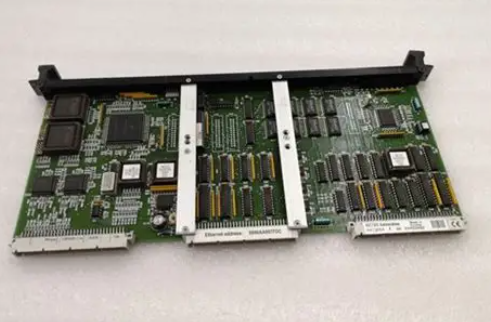
METSO D100314 Bus Buffer / Bus Interface Module

The METSO D100314 is an essential electronic component belonging to the Metso DNA (formerly Valmet DNA) automation system.

It is specifically identified as a Bus Buffer Module or Bus Interface Unit, used to ensure signal integrity and electrical isolation across the system’s communication backplane.

1. Product Description

The METSO D100314 is a specialized interface card designed to manage and amplify signals within a Distributed Control System (DCS).

In large-scale industrial setups, signals can degrade over long distances or through multiple rack connections;

the D100314 acts as a buffer to maintain high-speed data communication between the Central Processing Units (like the A413 series) and various I/O modules.

Type: Bus Buffer / Bus Interface Module

System Architecture: Valmet/Metso DNA

Function: Signal conditioning, bus expansion, and electrical isolation.

2. Technical Data Sheet (Specifications)

D100314

ParameterSpecification
Model NumberD100314
Part TypeBus Buffer Board
Operating Voltage24V DC (Internal system supply)
Power ConsumptionLow-wattage industrial design
IsolationGalvanic isolation between bus segments
Signal SpeedOptimized for Metso proprietary high-speed backplane
MountingRack-mounted (Plug-in module)
WeightApprox. 0.5 kg
IndicatorsLED status for Power and Bus Activity

3. Related Models

The D100314 is a “support” module that works alongside primary controllers and interfaces:

A413110: Terminal Interface Unit.

A413654 / A413665: Network and Active Control Units (The “brains” that send data through the D100314).

D100315: Often a companion or alternative version with different channel configurations.

DCN / ACN nodes: Modern Metso DNA hardware that utilizes these bus buffers for rack expansion.

4. Application Cases

DCS Rack Expansion: Used when an automation system requires more I/O modules than a single rack can power/address, allowing the bus to extend to a second or third rack.

Signal Stabilization: Applied in environments with high electromagnetic interference (EMI) to “clean” the communication signal before it reaches the processor.

Large-Scale Mining Plants: Managing data flow in heavy-duty mineral processing lines where I/O stations are spread across large distances.

Paper Mills: Ensuring millisecond-accurate communication between sensors and controllers in high-speed paper machine sections.

5. Product Features and Advantages

Signal Integrity: Prevents data loss or “noise” from affecting the control logic, which is vital for safety-critical industrial processes.

Galvanic Isolation: Protects sensitive CPU boards from electrical surges or faults occurring on the I/O bus side.

Plug-and-Play Integration: Designed specifically for the Metso DNA backplane, requiring no complex software configuration to perform its buffering task.

Durability: Built to withstand the heat and vibration of industrial control cabinets.

Easy Diagnostics: Front-facing LEDs allow maintenance teams to verify at a glance if the bus segment is active and powered.

6. Other Models in the Same Series

The D100xxx series typically covers bus management and power distribution within the Metso ecosystem:

D100310 / D100311: Basic bus connection units.

D1004xx Series: Often refers to power distribution or specialized grounding modules.

D200xxx Series: Newer generation I/O and interface modules for the Valmet DNA platform.

METSO A413665 Active Control Unit (ACU) / Processor Module

The METSO A413665 is a critical electronic module within the Valmet / Metso DNA (formerly Metso Automation) system.

It is specifically categorized as an ACU (Active Control Unit) or a high-level Processor/Communication Board used to manage sophisticated industrial automation tasks.

1.  Product Description

The METSO A413665 serves as a core processing component in the Metso DNA distributed control system.

It is designed to execute complex control algorithms and manage high-speed data exchange between field devices and the operator interface.

Type: Active Control Unit (ACU) / Processor Module.

Manufacturer: Metso Automation (now Valmet).

Role: Acts as the primary logic controller or communication hub for a specific segment of the industrial process.

Form Factor: Industrial-grade PCB mounted within a ruggedized housing for rack installation.

2.  Technical Data Sheet (Specifications)

ParameterSpecification
Model NumberA413665
Product TypeACU (Active Control Unit) / Processor
WeightApprox. 1.8 kg (including housing)
Operating Voltage24V DC (System Integrated)
ConnectivityEthernet (TCP/IP), High-speed Serial, and System Bus
Processor TypeHigh-performance embedded industrial processor
IndicatorsMulticolor LED Status (Run, Fail, Power, Communication)
CoolingPassive convection / Cabinet airflow
StandardsCE, UL certified (standard for industrial automation)

3.  Related Models

The A413665 is often found in systems alongside these common components:

A413654 (NCU2): Often works in tandem with Network Control Units for wider system connectivity.

A413110 (TIU6): Used for terminal interface and I/O routing.

Neles ND9000: Intelligent valve controllers that communicate with the A413665.

Metso I/O Modules: Analog (AI/AO) and Digital (DI/DO) cards that report directly to this control unit.

A413665

4.  Application Cases

Mining & Metal Refining: Used in the control loops of large-scale grinding mills and flotation cells where precise timing is essential.

Pulp & Paper Processing: Managing the high-speed “Wet End” control and “Dry End” quality monitoring in Valmet paper machines.

Chemical & Petrochemical: Controlling safety-critical sequences and maintaining pressure/temperature stability in reactor vessels.

Power Plant Automation: Managing burner control systems and steam turbine monitoring in combined-cycle power plants.

5.  Product Features and Advantages

High Processing Speed: Capable of handling hundreds of PID loops and logic sequences simultaneously with minimal latency.

Industrial Hardening: Specifically designed to resist electromagnetic interference (EMI) and vibration commonly found in heavy industrial plants.

Hot-Swap Capability: In redundant configurations, these modules can often be replaced without shutting down the entire control process.

Advanced Diagnostics: Provides deep-level system logs that can be accessed remotely for predictive maintenance.

Scalability: Allows for the expansion of the Metso DNA system by simply adding more units to the network.

6.  Other Models in the Same Series

The Metso/Valmet A413xxx series includes several specialized boards:

A413660 / A413662: Alternative processor or memory variants within the ACU family.

A413000 Series: Various power supply and bus-coupling modules.

DCN / ACN Series: Active Control Nodes that represent the modern evolution of the A413 series architecture.

METSO A413325 Rack module

METSO   A413325   Rack module

Turbine vibration analysis

Principles ( on top of protection solution)

Further scalar values are calculated from signals– for improved indication of developing faults, to have longer warning time and planning tome for

actionse)– like; 1x+phase, 2x+phase, 0.5x, Smax

Also vector type datas ( signals, spectrums, orbit plots) are provided– for vibration specialist to make a detailed analysi of situation and severity of possible fault

Techically this means– a process controller with vibration calculation functions in the end of the I/O group– history database into which measurements are collected (process historian)

trends, spectrum, etc histories

A413325

steady state data and run-up/coast data can be shown separately, so run-ups where you run

through turbine critical speeds can be verified and compared to earlier run-ups as events– additional tools into DNA Operate for follow-up  and reaction into alarms (operators) and also

vibration analysis tools– vibration versus process status is easy to compare since histories are in same database

Valmet DNA Machine Monitoring

System technology for auxiliary machines (BOP), non-protective

• Data processing in process controller- ACN CS, ACN RT, ACN MR

• ACN I/O modules, diagnostic only- Two 8-channel I/O units for fast dynamic

measurements (AIF8V and AIF8T)- Max. 128 channels per I/O group, 2 pcs MBI8- Several I/O groups can be connected to one

ACN- ACN I/O are M120 series- Rules of thumb (PCS sizing, RAM based)- one full I/O group with MR G2- but max 11 cards if MR in the I/O group- Two full I/O groups per ACN CS- Three full I/O groups per ACN RT G4

Valmet DNA Machine Monitoring

System technology for auxiliary machines (BOP), protective (API 670 type)

• ACN I/O modules, with protection calculation-AIF4V, AIF4E cards ( like for turbines)-Max. 16 cards / group ( 64 channels ) with

2xMBI8-Several I/O groups can be connected to one

ACN-ACN I/O are M120 series

•Diagnostic data processing in process controller-ACN CS, ACN RT, ACN MR-For diagnostics, rules of thumb (PCS sizing, RAM

based)-Two full I/O groups per ACN CS-one full I/O group with MR G2-but max 11 cards if MR in the I/O group-Three full I/O groups per ACN RT G

Possible signals:

•Vibration (IEPE)

•Shaft movement(eddy probe)

•Trigger (RTS-xxx)

•General analog (mA or V)

Connection into DNA MM:

•Star Ethernet (I/O bus)

•Chained I/O bus

•POE (I/O bus), single line

•Wireless Ethernet (I/O bus

METSO A413654 Central Control Module / NCU2 Processor Board

The METSO A413654 is a specialized industrial control component, specifically identified as an NCU2 (Network Control Unit) or Central Control Module.

It is used within the Valmet/Metso DNA automation systems, which are common in heavy industries like mining, pulp & paper, and power generation.

1. Product Description

The METSO A413654 (NCU2) is a high-performance central control module designed to manage data communication and logic execution within a Distributed Control System (DCS).

It acts as a “brain” or a critical communication bridge between various I/O modules and the higher-level monitoring system.

Manufacturer: Valmet / Metso Automation (often branded as Neles/Valmet)

Part Type: Central Control Module / NCU2 Processor Board

Function: Handles system-level communication, diagnostic processing, and interface management for industrial automation networks.

2. Technical Data Sheet (Specifications)

ParameterSpecification
Model NumberA413654
DesignationNCU2 (Network Control Unit 2)
Input VoltageSystem bus-powered (typically 24V DC environment)
WeightApprox. 1.7 kg
Indicator LightsFront-panel LEDs for Power, Run, Fault, and Link status
CommunicationHigh-speed Ethernet and proprietary Metso fieldbus support
EnvironmentOperating temp 0°C to +50°C; non-condensing humidity
Country of OriginFinland

3. Related Models

The A413654 is part of a modular family. It is frequently seen alongside:

A413110 (TIU6): Terminal Interface Unit often paired with this control module.

A41365x Series: Various iterations of processor and communication boards.

IOP345: Digital Input Modules that feed data into the NCU2.

Valmet DNA AC800M: Larger scale controllers that may integrate with these legacy boards.

A413654

4. Application Cases

Mining & Aggregates: Monitoring and controlling Metso Lokotrack® mobile crushing plants and Nordberg® NP Series impactors.

Pulp & Paper: Managing process logic in Valmet-controlled paper mills, where high-speed synchronization is required for the web press.

Oil & Gas: Integrating safety systems and process automation for Neles valve assemblies in offshore or refinery settings.

Power Generation: Used in DCS systems for coal-fired or renewable power plants to monitor turbine and generator parameters.

5. Product Features and Advantages

Real-time Diagnostics: Provides immediate feedback via onboard LEDs, allowing technicians to identify network or power faults instantly.

High Reliability: Designed for “always-on” industrial environments where system downtime can cost thousands of dollars per hour.

Network Stability: The NCU2 architecture is optimized for stable data throughput even in high-interference (EMI) industrial zones.

Backward Compatibility: Often used as a drop-in replacement or upgrade for older NCU units, extending the life of existing Metso DNA systems.

6. Other Models in the Same Series

A413651 / A413652: Earlier versions or specific variants of the NCU processor series.

A413100: Basic interface cards.

Valmet I/O Series: Analog and digital modules that share the same backplane and control logic architecture.

METSO A413110 PCB Card / Interface Board

Here is the comprehensive English product information for the METSO A413110

1.   Product Description

The METSO A413110 (often identified as the TIU6 or TIU 6 card) is a high-performance PC Board PLC / Add-On Board designed for industrial automation and process control.

It is part of the legacy Valmet/Metso automation series, primarily used for interfacing and managing control logic within distributed control systems (DCS).

Type: PCB Card / Interface Board

Designation: TIU6 (Terminal Interface Unit)

Manufacturer: Metso Automation (now part of Valmet)

Mounting: Slot-based mounting in standard PLC racks or sub-racks.

2.   Technical Data Sheet (Specifications)

ParameterSpecification
Model NumberA413110
Part NumberA413110 / TIU6
WeightApproximately 1.7 kg (0.02 lbs for the bare board)
Input VoltageSystem-dependent (standard PLC levels)
IndicatorsIntegrated LED status indicators (Power, Run, Fault)
Country of OriginFinland / USA
InterfaceTerminal Interface Unit (TIU) communication protocols
CoolingNatural convection / Rack airflow

3.   Related Models

The A413110 is often used in conjunction with other components of the Metso/Valmet DNA system or the Neles ValvGuard series.   Related hardware includes:

A413100: Similar interface board series.

VG9000 Series: Intelligent safety solenoids often controlled via Metso automation boards.

Metso AC800M: Common PLC platform where these boards may be integrated.

I/O Modules: Various digital and analog input/output cards compatible with the TIU6 rack.

4.   Application Cases

The METSO A413110 is typically found in heavy industrial environments requiring high reliability:

Mining & Aggregates: Used in the automation of Lokotrack® mobile crushers and Nordberg® stationary plants to manage motor controls and safety interlocks.

Pulp & Paper: Integration into Valmet DNA systems for paper machine control.

Oil & Gas: Controlling ESD (Emergency Shutdown) and ESV (Emergency Venting) valves via partial stroke testing systems.

Power Plants: Managing auxiliary control loops and data acquisition from field sensors.

5.   Features and Advantages

Reliability: Built for 24/7 operation in harsh industrial environments (dust, vibration, and temperature fluctuations).

Real-time Diagnostics: Features LED indicators on the front panel for immediate troubleshooting of power and communication status.

Modular Design: The “Slot Mounting” design allows for quick replacement (Hot-swapping in supported frames), minimizing downtime during maintenance.

Integration: Seamlessly communicates with HART and Foundation Fieldbus protocols when used in Valmet automation architectures.

Longevity: Even as a discontinued manufacturer item, it is highly sought after for its durable build quality in “Life Cycle Services.”

A413110

6.   Other Models in the Same Series

In the Valmet/Metso automation catalog, you will often find:

A413xxx Series: Boards ranging from power supply modules to communication processors.

TIU Series: TIU1. TIU2. and TIU6 boards, which differ based on the number of channels or the specific protocol translation they handle.

Neles ValvGuard VG9000: Often the field-side “partner” to these control cards.

Woodward 85018V2 505E Digital Governor for Extraction Steam Turbines

85018V2

505E Digital Governor

for Extraction Steam Turbines

505 HMI Software

Woodward offers two different HMI software packages, OpView and 505View,

which allow an operator to remotely view operating inputs, adjust control

setpoints, issue Run mode commands, and monitor/troubleshoot the turbine

control.    Both HMI packages are self-configuring which eliminates all field

engineering—they automatically configure their screens to match the control’s

programmed application.

The OpView is comprised of an industrialized NEMA 4 touchscreen hardware

package bundles together with a Woodward developed software interface

program.    The 505View is a unbundled Intellution-based software package that

runs on a pc (hardware can be optionally purchased).    Both HMI packages are

pre-configured to communicate via Modbus® * protocol with either a 505 or 505E

Woodward steam turbine control and offer the following features.

*—Modbus is a trademark of Schneider Automation Inc.

Automatic Screen Generation based on control configuration

Security with multiple User Levels

Remote Access Capability1

Real-Time and Historical Trending2

Alarm/Trip Status Indication

Alarm/Trip Log with Time Tagging and First-Out Indication

I/O and System Troubleshooting

Graphic System Control screens

Event Status Logging and History3

85018V1

Notes:

1 505View only

2 OpView has Real-Time Trending only;    505View has both

3 OpView has Logging only;    505View has Logging and History

automatically configures its screens to match the 505E’s programmed

application.  If the 505E is not configured to accept Modbus commands, the HMI

functions as a system monitor only.  If the 505E is configured to accept Modbus

commands, all 505E Run Mode operations can be monitored and performed

through it (start, stop, mode enable/disable, setpoint raise/lower).  For safety

purposes, the Overspeed test function can not be performed through the HMI.

See Volume 1. Chapter 7 of this manual for more information on programming

Modbus ports.

User-friendly touch screens allow operators to view and control multiple modes of

operation and setpoints from one screen.  Ten different screens are available to

allow operators the flexibility of viewing.  These screens display the following

85018V1

information:

Controlling parameter information

Complete starting sequences

Turbine and/or Generator information

Speed, Extr/Adm, Aux, Casc, & Limiter information

Analog Input and Output levels

Contact Input and Relay Output states

Alarm and Shutdown Log

The OpView or 505View can interface with the 505E through serial RS232.

RS422. or RS485 communications.  By using RS422 or RS485 communications,

the HMI can be located up to 4.000ft (1.220meters) from the 505E digital control.

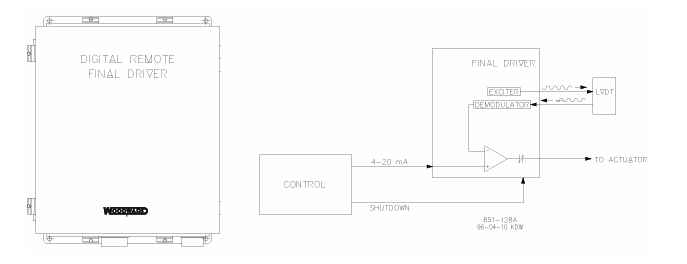
Digital Remote Final Driver

Digital Remote Final Driver (DRFD) is used to interface the 505E digital control to

existing valve operators or Woodward actuators that are integrating in action or

are not compatible with the 505E.

The 505E’s actuator outputs have the capability of driving a 4–20 mA or 20–160

mA (200 mA max) proportional signal into an actuator coil. These 505E actuator

output signals represent a demand signal equal to desired valve position

(proportional). If the application’s actuator or servo assembly requires a different

drive signal, or control action (integrating with a null setting), a Digital Remote

Final Driver or equivalent device must be used.

Woodward Digital Remote Final Drivers accept a 4–20 mA actuator-drive signal

proportional to desired valve position, and position a servo assembly accordingly.

Integrating or proportional type DRFDs are available depending on the servo

assembly being interfaced to. Woodward DRFDs have the capability of driving

unipolar or bipolar actuator demand signals, up to 0–400 mA or +400 mA

respectively.

The Digital Remote Final Driver is housed in a NEMA-4X enclosure with a hinged

cover and consists of driver and power supply modules. The driver module uses

plug-in jumpers and an alphanumeric display to facilitate field configuration and

calibration.

Proportional type DRFDs can provide an output drive signal of up to 400 mA, to

be compatible with existing servo assemblies. This drive signal is proportional to

the 4–20 mA input signal received from the 505E digital control.

Integrating type DRFDs sense actual valve position (through, LVDTs, RVDTs,

MLDTs, or DC position feedback devices), compare this signal to the input

position demand signal from the 505E, and output a drive signal to position a

servo assembly accordingly. See Figure 1-2.

Please refer to Woodward Product Spec 85532 for more information on DRFDs

and their capabilities.

Real Power Sensor

A Real Power Sensor is used to sense the real power produced by a generator

or flowing through a tie line. Woodward Real Power Sensors sense three-phase

volts, three-phase amps, compare each phase’s voltage to current relationship,

and develop a 4–20 mA output proportional to real power.

Woodward manufactures two types of Real Power Sensors. The first type of RPS

is designed to sense power flow in one direction only (0 to +5 A CT current only),

and output a proportional 4–20 mA signal. This type of RPS was designed for

and should be used to sense generator power output. Many different real power

sensors of this type exist. Some of the optional RPS features include VAR

sensing, Loadsharing, 0–1 A CT current sensing, and multiple combinations of

these. Please consult a Woodward certified distributor or a Woodward factory for

the recommended RPS for your application.

The second type of RPS manufactured by Woodward is designed to sense

power flow through a bus-to-bus tie line. This RPS (8272-726) senses –5A to

+5A CT current to allow its output to represent power flow in both directions. This

RPS provides a 4–20 mA power indication output signal where 12 mA represents

0 power flow. It is recommended that this RPS be used to sense power flow

through a tie line only. This RPS or equivalent is required to sense plant Import

and Export power.

Woodward Real Power Sensors have terminals labeled “Output” and terminals

labeled “KW Readout”. The “KW Readout” terminals provide a 4–20 mA signal

proportional to real power which is used by and compatible with the 505E control.

Thus the RPS terminals labeled “Output” are designed and typically compatible

only to Woodward’s 2301 type of control

Woodward manufactured Real Power Sensors have a 2.5 Hz Low pass filter (400

ms lag time) on their output to filter out the high frequency noise typically created

in a switch gear type environment. Thus if another vendor’s watt transducer is

used, verification that it has similar filtering criteria should be performed before it

is applied with the 505E. For more information on Woodward Real Power

Sensors, please refer to Woodward manual 82018.

Digital Synchronizer and Load Control (DSLC™)

The Woodward DSLC™ is a microprocessor based generator load control

designed for use on three-phase AC generators with Woodward speed controls

and automatic voltage regulators. The DSLC is a synchronizer, a load control, a

dead bus closing system, a VAR/PF control, and a process control, integrated

into one package.

The 505E can be programmed to use the DSLC as a synchronizer only, or as a

synchronizer and load control. The DSLC provides either phase match or slip

frequency synchronizing, and ties into the unit automatic voltage regulator to

match voltages before paralleling. It interfaces with the 505E via a Speed bias

signal to control generator frequency and phase. When configured to use the

DSLC as a synchronizer only, the 505E must be programmed to receive the

DSLC Speed Bias signal through an analog input and have this input enabled

through a contact input or function key.

The DSLC communicates over a LAN using a digital Echelon network with other

system DSLCs to enable it to perform safe deadbus closings. Because the DSLC

performs all synchronizing functions simultaneously, synchronization typically

takes only a few seconds.

When used as a synchronizer and load control, the DSLC performs automatic

synchronization, and controls unit load based on the DSLCs mode of operation.

The DSLC can be in a base-load, loadsharing, remote load setting, or Process

control mode, depending on configuration and system conditions.

The DSLC’s baseload mode of operation allows an operator to set the unit to a

specified load. A proportional or integrating control action can be used with this

mode of operation. The integrating mode of operation can be used with systems

tying to an unstable grid to allow the unit to control at a constant load and not

vary based on grid frequency.

The DSLC’s loadsharing mode is used to share load with any other units using a

DSLC and tied to the same isolated bus. This mode is used in conjunction with a

Master Synchronizer & Load Control when paralleled to a utility to allow the

MSLC to control plant frequency or load depending on its state of operation.

The DSLC’s remote load setting mode allows load to be set by a remote 4–20

mA signal. The DSLC’s Process control mode allows any process directly related

to generator load to be controlled.

When using the DSLC as both a synchronizer and load control, the 505E control

must be programmed to receive the DSLC Speed Bias signal through an analog

input and have this input enabled through a contact input or function key.

After synchronization, unit load can be controlled by the DSLC (through the 505E

Sync/Ld input) or by the 505E’s internal speed/load setpoint. When the Sync/Ld

Share input is programmed, the position of the Utility Tie Breaker Contact selects

unit load control through the DSLC or through the 505E’s internal load setpoint.

The DSLC interfaces to the 505E via a Speed Bias signal. From the many

different types of DSLCs manufactured by Woodward only a few have a Speed

Bias output (1–5 Vdc) compatible with the 505E control. The 505E’s isolated

analog #6 input is the only analog input that is directly compatible with the DSLC.

Thus the DSLC’s speed bias output should only be connected to the # 6 analog

input. The DSLC’s speed bias output is designed to drive into the 505E’s low

impedance input.

Once the generator is synchronized the DSLC soft-loads the unit to the load

setting determined by the mode of operation (base load, loadsharing, Process

control). When commanded the DSLC can also soft-unload the unit and issue a

breaker-open command at a set power level.

Installation Notes

Hand-held Programmer (9905-292) is required and used by the DSLC to

configure and calibrate it to the site specific application.

The DSLC requires a power source of +24Vdc @ 1 A. The 505E power supplies

can not supply this much power, thus an external power supply may be required.

The DSLC can interface with the unit Automatic Voltage Regulator through

contacts or a +9 volt bias signal.

For more information on Woodward’s Digital Synchronizer & Load Control,

please refer to Woodward manual 02007.

Woodward 85018V1 Turbine Control Parameters

Turbine Control Parameters

The 505E interfaces with two control valves (HP & LP) to control two parameters

and limit an additional parameter, if desired. These two controlled parameters are

typically speed (or load) and extraction/admission pressure (or flow), however,

the 505E could be utilized to control or limit: turbine inlet pressure or flow,

exhaust (back) pressure or flow, first stage pressure, generator power output,

plant import and/or export levels, compressor inlet or discharge pressure or flow,

unit/plant frequency, process temperature, or any other turbine related process

parameter. Refer to Volume 2 for details on applications.

Communications

The 505E can communicate directly with plant Distributed Control Systems

and/or CRT based operator control panels, through two Modbus® *

communication ports. These ports support RS-232. RS-422. or RS-485

communications using ASCII or RTU MODBUS transmission protocols.

Communications between the 505E and a plant DCS can also be performed

through hardwired connections. Since all 505E PID setpoints can be controlled

through analog input signals, interface resolution and control is not sacrificed.

*—Modbus is a trademark of Schneider Automation Inc.

Additional Features

The 505E also provides the following features: First-Out Trip Indication (5 total

trip inputs), Critical Speed Avoidance (2 speed bands), Auto Start Sequence (hot

& cold starts), Dual Speed/Load Dynamics, Zero Speed Detection, Peak Speed

Indication for Overspeed trip, and Isochronous Loadsharing between units.

Using the 505E

The 505E control has two normal operating modes, the Program Mode and the

Run Mode. The Program Mode is used to select the options needed to configure

the control to your specific turbine application. Once the control has been

configured, the Program Mode is typically never again used, unless turbine

options or operation changes. Once configured, the Run Mode is used to operate

the turbine from start-up through shutdown. In Addition to the Program and Run

modes, there is a Service Mode which can be used to enhance system operation

while the unit is running. Refer to Volume 2 for information on the Service Mode.

505E Inputs and Outputs

Control Inputs

Two speed inputs which are jumper configurable for MPU (magnetic pickup units)

inputs or proximity probes.

Six analog inputs are available.  One is dedicated as the extraction/admission

input.  The remaining five are configurable.  The sixth analog input has isolation

circuitry and should be used for a self-powered signal that is not isolated.

Sixteen contact inputs are available. Four are dedicated for shutdown, reset,

raise speed setpoint, and lower speed setpoint. Another two contact inputs must

be dedicated for generator breaker and utility tie breaker if the control is used in a

generator application. Ten additional contact inputs can be configured. If the unit

is not used in a generator application, then twelve additional contact inputs can

be configured.

Four function keys on the front panel of the control. F1 and F2 are dedicated to

alarm and overspeed test, respectively. F3 and F4 can be used to enable or

disable various functions of the control.

85018V1

Control Outputs

Two actuator outputs with linearization curves for the HP and the LP valve

outputs.

Six 4–20 mA outputs, for meters or other readouts.

Eight Form-C relay contact outputs, six that are configurable. The two dedicated

relay outputs are for shutdown and alarm indication.

Control Communications

Two Modbus ports, to be used as control interfaces. The protocol can be either

ASCII or RTU and the communications can be RS-232. RS-422. or RS-485.

One computer (PC) port to be used for program configuration storage.

An overview of the 505E functions is shown in Figure 1-1. Use this block diagram

to match the control features to the site-specific application required.

The 505E Digital Governor is designed to control extraction, extraction/

admission, or admission steam turbines. The difference between these turbines

is the capability of the turbine to allow low pressure steam, which is at a lower

pressure than the inlet, to enter and/or exit the turbine. An extraction turbine

allows the lower pressure (extraction) steam to exit the turbine only and will have

a non-return valve in the extraction header/line to prevent steam from entering

the turbine. An admission turbine (also called induction) will allow excess header

steam to enter the turbine through the low pressure inlet. An extraction/admission

turbine will allow low pressure header steam to enter or exit the turbine

depending on system pressures. A turbine with admission capability will have a

stop valve or trip-and-throttle valve in the low pressure line to prevent steam from

entering the turbine when the unit is tripped. The type of turbine used will depend

on the system requirements and must be designed by the turbine manufacturer

to perform the functions required.

The 505E has two independent control channels available, the speed/load and

auxiliary controllers. The outputs of these two controllers are low-signal-selected

(LSS) to provide to speed/load demand signal to the ratio/limiter. In addition to

these channels, the speed/ load controller can be manipulated by another

controller, the cascade controller. The cascade controller is ‘cascaded’ into the

speed controller, whereby the speed controller setpoint is changed directly by the

cascade controller output. The auxiliary controller can act as either a control

channel or as a limiting channel. All three of these PID controllers have the

option of utilizing an analog input signal to remotely position their setpoints.

Additional features of the 505E include frequency control, isochronous

loadsharing, critical speed avoidance, idle/rated control, and an automatic start

sequence. There are two serial communications ports which can be used to

monitor and control the turbine using Modbus protocol.

85018V1

Extraction Turbines

The 505E control can be configured to operate single automatic extraction

turbines by controlling the interaction of the governor (HP or high pressure) valve

and the extraction (LP or low pressure) valve. (The 505E can also operate the

governor valve and the first extraction valve of multiple extraction turbines).

Single automatic extraction turbines have a high pressure stage and a low

pressure stage, each controlled by a valve. Steam enters the turbine through the

HP valve (see Figure 1-2). At the downstream end of the HP turbine stage and

before the LP valve, steam can be extracted. The LP valve controls the entry of

steam into the LP turbine stage, and the diverting of steam through the extraction

line. As the LP valve is opened, more steam enters the LP stage and less is

extracted.

In most cases, the operator of an extraction turbine needs to maintain both

turbine speed/ load and extraction pressure/flow at constant levels. Changing the

position of either the HP valve or the LP valve affects both turbine speed/load

and extraction. If either the load on the turbine or the extraction demand

changes, both the

Admission Turbines

The 505E control can be configured to operate single automatic admission

turbines by controlling the interaction of the governor (HP or high pressure) valve

and the extraction (LP or low pressure) valve.

Single automatic admission turbines have a high pressure stage and a low

pressure stage, each controlled by a valve.  Steam enters the turbine through the

HP valve (see Figure 1-3) and at the downstream end of the HP turbine stage,

before the LP valve.  The LP valve controls the entry of steam into the LP turbine

stage and through the admission line.  As the LP valve is opened, more steam

enters the LP stage.

In most cases, the operator of an admission turbine needs to maintain both

turbine speed/ load and admission pressure/flow at constant levels.  Changing the

position of either the HP valve or the LP valve affects both turbine speed/load

and admission.  If either the load on the turbine or the admission demand

changes, both the HP valve position and the LP valve position must be changed

to maintain speed/load and admission.

The movement of both valves is automatically calculated by the 505E’s ratioing

logic based on the turbine performance parameters to minimize valve/process

interaction.

Extraction and Admission Turbines

The 505E control can be configured to operate single automatic extraction and

admission turbines by controlling the interaction of the governor (HP or high

pressure) valve and the extraction (LP or low pressure) valve.

Single automatic extraction and admission turbines have a high pressure stage

and a low pressure stage, each controlled by a valve.  Steam enters the turbine

through the HP valve (see Figure 1-2).  At the downstream end of the HP turbine

stage and before the LP valve, steam can either be extracted or admitted

(inducted) into the LP turbine stage.  The LP valve controls the entry of steam into

the LP turbine stage.  As the LP valve is opened, more steam enters the LP stage

and less is extracted.

In most cases, the operator of an extraction turbine needs to maintain both

turbine speed/ load and extraction or admission pressure/flow at constant levels.

Changing the position of either the HP valve or the LP valve affects both turbine

speed/load and extraction or admission.  If either the load on the turbine or the

extraction / admission demand changes, both the HP valve position and the LP

valve position must be changed to maintain speed/ load and extraction/

admission.  The movement of both valves is automatically calculated by the

505E’s ratioing logic based on the turbine performance parameters to minimize

valve/process interaction.

Speed Control

The speed control receives a turbine speed signal from one or two magnetic

pickups or proximity probes.  The speed PID (proportional, integral, derivative)

control amplifier then compares this signal to the speed setpoint to generate an

output signal to the ratio/ limiter (through a low signal select bus).

Extraction/Admission Control

The Extraction/Admission (Extr/Adm) control receives an extraction/admission

(4–20 mA) signal from a pressure or flow transducer. The Extr/Adm PID

controller then compares this signal to the setpoint to generate an output signal

to the Ratio/Limiter.

The Extr/Adm control can also receive a programmable (optional) droop

feedback signal to increase the stability of the extraction control loop.

The Extr/Adm setpoint is adjustable with raise or lower commands through the

keypad on the front of the control, the remote contact inputs, or the

communication links. Also, the setpoint can be directly set by entering the new

setpoint from the keypad or through either Modbus communications link. In

addition, a remote extr/adm setpoint analog input can be programmed to

remotely position the Extr/Adm setpoint.

Remote Extraction/Admission Setpoint

One of the 4–20 mA inputs can be configured to remotely adjust the Extr/Adm

setpoint. The remote setpoint input directly affects the 505E’s Extr/Adm setpoint.

The maximum rate at which the remote input signal can change the setpoint is

programmable and can be changed in the Run mode. When the remote setpoint

is enabled, the Extr/Adm setpoint will move at a much slower rate until the two

settings are matched, at which point the setpoint will be allowed to move at the

maximum rate. The remote setpoint function can be enabled and disabled as

required from the front-panel keypad, the remote contact inputs or either Modbus

communication link.

Ratio/Limiter

The Ratio/Limiter receives input signals from the speed (or aux) and extr/adm

control PIDs. The ‘ratio’ logic uses these signals and, based on the turbine

performance parameters, produces two output signals, one to control the HP

actuator and one to control the LP actuator. The ‘limiter’ logic keeps the actuator

outputs within the boundaries of the turbine steam map.

The ratio logic controls the interaction of both HP and LP valves to maintain

desired turbine speed/load and extraction/admission pressure/flow levels. By

controlling valve interaction, the ratio logic minimizes the effects of one controlled

process on the other controlled process.

When speed/load or extraction/admission demands cause the turbine to reach an

operating limit, the limiter logic limits the HP or LP valves to maintain speed/load

or extraction/ admission demands depending on the priority selected

Woodward 26871 505 Enhanced Digital Control for Steam Turbines

26871 505 Enhanced Digital Control for Steam Turbines

Replacement/Exchange: Replacement/Exchange is a premium program designed for the user who is in need of

immediate service.  It allows you to request and receive a like-new replacement unit in minimum time (usually within

24 hours of the request), providing a suitable unit is available at the time of the request, thereby minimizing costly

downtime.

This option allows you to call your Full-Service Distributor in the event of an unexpected outage, or in advance of a

scheduled outage, to request a replacement control unit.  If the unit is available at the time of the call, it can usually be

shipped out within 24 hours.  You replace your field control unit with the like-new replacement and return the field unit

to the Full-Service Distributor.

Flat Rate Repair: Flat Rate Repair is available for many of the standard mechanical products and some of the

electronic products in the field.  This program offers you repair service for your products with the advantage of

knowing in advance what the cost will be.

Flat Rate Remanufacture: Flat Rate Remanufacture is very similar to the Flat Rate Repair option, with the exception

that the unit will be returned to you in “like-new” condition.  This option is applicable to mechanical products only.

Returning Equipment for Repair

If a control (or any part of an electronic control) is to be returned for repair, please contact your Full-Service

Distributor in advance to obtain Return Authorization and shipping instructions.

When shipping the item(s), attach a tag with the following information:

 return number;

 name and location where the control is installed;

 name and phone number of contact person;

 description of the problem;

 complete Woodward part number(s) and serial number(s);

 instructions describing the desired type of repair.

Contacting Woodward’s Support Organization

For the name of your nearest Woodward Full-Service Distributor or service facility, please consult our worldwide

directory published at www.woodward.com/directory.

You can also contact the Woodward Customer Service Department at one of the following Woodward facilities to

obtain the address and phone number of the nearest facility at which you can obtain information and service.

Products Used In

Regulatory Compliance & Declarations

European Compliance for CE Marking:

These listings are limited only to those units bearing the CE Marking.

EMC Directive:

ATEX – Potentially

Explosive

Atmospheres

Directive:

North American Compliance:

Declared to 2004/108/EC COUNCIL DIRECTIVE of 15 December 2004

on the approximation of the laws of the Member States relating to

electromagnetic compatibility and all applicable amendments.

Declared to 94/9/EEC COUNCIL DIRECTIVE of

23 March 1994 on the approximation of the laws

of the Member States concerning equipment

and protective systems intended for use in potentially explosive

atmospheres.

Zone 2. Category 3. Group II G, EEx nA II T3 X

These listings are limited only to those units bearing the UL agency identification.

UL:

UL Listed for Class I, Division 2. Groups A, B, C, & D

T3A at 60 °C Ambient (NEMA 4X or similar enclosure provided)

T3B at 65 °C Ambient (NEMA 4X or similar enclosure omitted)

For use in Canada and the United States per UL File E156028

Wiring must be in accordance with North American Class I, Division 2 or European Zone 2 wiring

methods as applicable, and in accordance with the authority having jurisdiction.

Marine Compliance (24 V Version Only)

Det Norske Veritas (DNV):

Certified for Marine Applications, Temperature Class B, Humidity Class

B, Vibration Class A, EMC Class A, and Enclosure Class B per DNV

Rules for Ships, Pt. 4. Ch. 9. Control and Monitoring Systems.

Other International Compliance

C-Tick:

(ACA/RSM)

Declared to Australian Radiocommunications

Act of 1992 and the New Zealand Radiocommunications Act of 1989.

GOST-R: Certified for use in explosive atmospheres within the Russian Federation

per GOST-R certificate РОСС US.ГБ04.В01002 with marking

2ExnAIIT3Х

Special Conditions For Safe Use

Field wiring must be stranded copper wire rated at least 75 °C for operating ambient temperatures

expected to exceed 50 °C.

Peripheral equipment must be suitable for the location in which it is used.

A fixed wiring installation is required.

Grounding is required by the input PE Terminal.

A switch or circuit breaker shall be included in the building installation that is in close proximity to the

equipment and within easy reach for the operator and is clearly marked as the disconnecting device for

the equipment.

Woodward 03365 505E (Extraction / Admission)

Product Specification 03365

505E (Extraction / Admission)

Digital Control for Steam Turbines Applications

The 505E controller is

designed to operate

single-extraction

and/or admission

steam turbines of all

sizes and

applications. This

steam turbine

controller includes

specifically designed

algorithms and logic

to start, stop, control,

and protect single

extraction and/or

admission steam

turbines or turboexpanders, driving generators, compressors, pumps, or industrial fans. The 505E

control’s unique PID structure makes it ideal for applications where it is required to

control steam plant parameters like turbine speed, turbine load, turbine inlet

pressure, exhaust header pressure, extraction or admission header pressure, or tie

line power.

The control’s special PID-to-PID logic allows stable control during normal turbine

operation and bumpless control mode transfers during plant upsets, minimizing

process over- or undershoot conditions. The 505E controller senses turbine speed

via passive or active speed probes and controls the steam turbine through HP and

LP actuators connected to the turbine steam valves.

03365

The 505E controller senses extraction and or admission pressure via a 4–20 mA

transducer and uses a PID through a ratio/limiter function to accurately control

extraction and/or admission header pressure, while protecting the turbine from

operating outside of its designed operating envelope. The controller uses the specific

turbine’s OEM steam map to calculate its valve-to-valve decoupling algorithms and

the turbine operating and protection limits.

Description

The 505E control is packaged in an industrial hardened enclosure designed to be

mounted within a system control panel located in a plant control room or next to the

turbine. The control’s front panel serves as both a programming station and operator

control panel (OCP). This user-friendly front panel allows engineers to access and

program the unit to the specific plant’s requirements, and plant operators to easily

start/stop the turbine and enable/disable any control mode. Password security is

used to protect all unit program mode settings. The unit’s two-line display allows

operators to view actual and setpoint values from the same screen, simplifying

turbine operation.

Turbine interface input and output wiring access is located on the controller’s lower

back panel. Unpluggable terminal blocks allow for easy system installation,

troubleshooting, and replacement.

Cost‐Effective Design

The 505E control is designed to function as the turbine control,

system sequencer, operator control panel, and first-out

indicator. This encompassing design minimizes external

system devices as well as system installation, wiring, and

troubleshooting.

03365

This field configurable controller allows major functional changes

to be made at site, often by knowledgeable plant personnel, and

minor functional changes to be on-line as process changes

require. The 505E control’s first-out-indicator logic indicates

internal as well as external system related alarm and shutdown

conditions, greatly simplifying and reducing system

troubleshooting.

Communications

The 505E controls can communicate directly with plant

Distributed Control Systems and/or CRT-based operator

control panels, through two Modbus® * communication ports.

These ports support RS-232. RS-422. and RS-485

communications using ASCII or RTU Modbus protocols.

Communications between the 505E and a plant DCS can also

be performed through hardwired connections. Since all 505E

PID setpoints can be controlled through analog input signals,

interface resolution and control is not sacrificed.

*—Modbus is a trademark of Schneider Automation Inc.

System Protection

 Integral Overspeed Protection Logic

 First-out Indication (10 individual shutdown inputs)

 Turbine Operating Envelope Limiters

 Bumpless transfer between control modes if a transducer

failure is detected

 Local/Remote Control priority and selection

 Failsafe Shutdown Logic

Control

The following PIDs are available to perform as process

controllers or limiters:

 Speed/Load PID (with Dual Dynamics)

 Extraction / Admission PID

 Auxiliary PID (limiter or control)

 Cascade PID (Header Pressure or Tie-Line Control)

Control Specifications

INPUTS

 Power: 18–32 Vdc, 90–150 Vdc, 88–132 Vac

(47–63 Hz), 180–264 Vac (47–63 Hz)

 Speed: 2 MPUs (1–30 Vrms) or proximity probes

(24 Vdc provided), 0.5 to 15 kHz

 Discrete Inputs: 16 Contact Inputs (4 dedicated,

12 programmable)

 Analog Inputs: 6 Programmable Current Inputs

(4–20 mA)

OUTPUTS

 Valve/Actuator Drivers: 2 Actuator Outputs (4–20 mA or

20–160 mA)

 Discrete Outputs: 8 Relay Outputs (2 dedicated,

6 programmable)

 Analog Outputs: 6 Programmable Current Outputs

(4–20 mA)

COMMUNICATION

 Serial: 2 Modbus (ASCII or RTU) Comm Ports

(RS-232. RS-422. or RS-485 compatible)

Control Accessories

Control Assistant (Configuration Management Tool)

The Woodward Control Assistant software program is a

computer-based service tool that can be used with the 505E

control to upload, save, and download controller

configurations. Optionally, this service tool can also be used to

trend unit parameters, to compare differences in configuration

files, and to verify if control settings have been changed.

Functionality

The 505E’s control capabilities are:

 Speed/Frequency Control

 Extraction / Admission Header Pressure Control

 Turbine or Generator Load Control or Limiting

 Turbine Inlet Header Pressure Control or Limiting

 Turbine Exhaust Header Pressure Control or Limiting

 Plant Import/Export Power Control or Limiting

 Isochronous Load Sharing between units (with DSLC™

control)

Features

 Critical Speed Avoidance (3 speed bands)

 Auto Start Sequence (hot & cold starts)

 Valve Limiter(s)

 Security (Program is Password Protected)

 Dual Speed/Load Dynamics

 First-Out Indication (Shutdowns)

 Zero Speed Detection with proximity probe (< 0.5 Hz)

 Peak Speed Indication for overspeed trip

 Two Programmable Functions Keys on the 505E’s front

panel

 Two independent Modbus comm links

 Remote analog setpoints for Speed/Load, Ext/Adm, Aux,

and Cascade

 Program upload/download capability

 Feed-forward decoupling algorithm for compressors

Operating Conditions

 –25 to +65 °C ambient air temperature range

 Optional NEMA type 4 (watertight and dust-tight, indoor/outdoor) enclosure for bulkhead mounting with a temperature range

from –25 to +55 °C

 Approximate dimensions 14L x 11H x 4D inches (356 x 279 x 102 mm)

 Approximate bulkhead enclosure dimensions 20L x 20H x 7.6D inches (508 x 508 x 193 mm)

 Humidity: Lloyd’s ENV2 test #1

 Dry heat: Lloyd’s ENV3

 Salt fog: US MIL-STD-810 method 509.2 procedure 1

 Shock: meets US MIL-STD-810C, method 516.2-1. procedure 1B

 Vibration: Lloyd’s ENV2 test #1

 Certifications: CE (18–32 Vdc version only), UL, & cUL

Pollution Resistance

 Particulate Pollution Resistance: IEC 664-1 Pollution Degree 2 (Normally only nonconductive pollution occurs. Temporary

conductivity caused by condensation is to be expected.)

 Gaseous Pollution Resistance: The polyacrylate conformal coating withstands NO2. CO2. SO2. and H2S gases per IEC

60068-2-60:1995 Part 2.60 Methods 1 and 4 (Flowing Mixed Gas Corrosion Test). It will withstand levels typical of

telecommunications and computer installations as defined by Battelle Labs Class III (between IEC 60721-3-3 classification

3C1 and 3C2. light industrial to urban industrial, heavy traffic).

METSO A413160 Pneumatic relay module

The Metso (now Neles/Valmet) A413160 is a critical pneumatic component, specifically the Spool Valve Assembly / Pneumatic Relay Module used within the Neles ND9000 series intelligent valve positioners.

It is the high-capacity version of the pneumatic amplifier stage.

1. Product Description

The A413160 is a high-flow pneumatic relay designed to control the flow of compressed air to large-scale actuators.

In an intelligent positioner, while the electronics (CPU board) provide the logic, the A413160 acts as the “power stage.” It translates low-power pilot signals into high-volume air movement to ensure large valves can open or close rapidly and accurately.

It features a precision-machined spool and sleeve design, optimized for long life and minimal friction, ensuring that the valve positioner can modulate with sub-millimeter precision.

2. Technical Parameters (Technical Data)

ParameterSpecification
Component TypeHigh-Flow Pneumatic Relay / Spool Valve
Supply Pressure1.4 – 8.0 bar (20 – 115 psi)
Max Air DeliveryApprox. 18 $Nm^3/h$ (at 6 bar supply)
Steady-state Air Consumption< 0.15 $Nm^3/h$ at 4 bar
Response TimeHigh-speed dynamic switching (< 10ms pilot response)
MediumClean, dry, oil-free compressed air or inert gas
Temperature Range-40°C to +85°C
MaterialAnodized Aluminum / Stainless Steel internals

3. Product Advantages & Key Features

High Flow Capacity: Specifically designed for large-volume actuators (like the Neles B1C/B1J 50 and above), significantly reducing the “Stroking Time.”

Minimal Hysteresis: The spool valve design ensures a linear relationship between the pilot signal and output flow, preventing “jumping” or erratic valve movement.

Internal Filtration: Equipped with fine-mesh protection screens to prevent pilot orifice clogging from instrument air debris.

Energy Efficient: Despite its high-flow capability, it maintains an extremely low bleed rate when the valve is in a steady state, saving plant air costs.

Field Replaceable: Modular design allows for the replacement of the entire relay unit in minutes without removing the positioner from the valve.

A413160

4. Application Cases

Large Bore Control Valves: Used on 12″ and larger butterfly or ball valves where massive air volumes are needed for movement.

Fast Action Dampers: Control of air intake or exhaust dampers in power plants requiring rapid modulation.

Anti-Surge Valves: In compressor stations where the valve must react within milliseconds to prevent catastrophic equipment damage.

High-Vibration Environments: Mining and pulp processing where mechanical stability of the pneumatic stage is vital for consistent control.

A413160

5. Related & Other Models in the Series

The A413160 is part of the modular pneumatic family for the ND9000:

ND9200: The high-flow version of the positioner that typically uses this A413160 relay.

A413152: The standard-flow relay version for smaller actuators.

A413120: An alternative relay module for specific older revisions of the ND9100.

B1-Series Actuators: The pneumatic cylinders (Double Acting or Spring Return) that this module powers.

A413111: The feedback potentiometer that works in tandem with this relay to confirm valve position.

Search for products

Back to Top
Product has been added to your cart
phone: +86 18150137010
to whats
+8618150137010
to whats
+8618150137010
email: industrialists.yan@gmail.com